What is Experience & Hybrid Art?
Some works of art hang on the wall. Others become accomplices.
“Experience & Hybrid Art ” most accurately describes my art precisely because it does not stop at a single image, a single technique, or a single perspective. These are works that emerge from multiple worlds—and continue to unfold as they are experienced: digital and analog, researched and intuitive, visible and hidden, in daylight and sometimes in a second light.
Experience means: A work of art doesn’t reveal itself all at once. It becomes an adventure of light, distance, and perspectives—and invites you to become part of this discovery.
“Hybrid ” means: The works are created by bringing together different worlds.
Experience: Art That Isn’t Over at First Glance
Experience begins when an image wants to be more than just visually appealing. Of course, art can be beautiful. It can transform spaces, draw the eye, and create an atmosphere. But it can also linger. Leave a lasting impression. Raise questions.
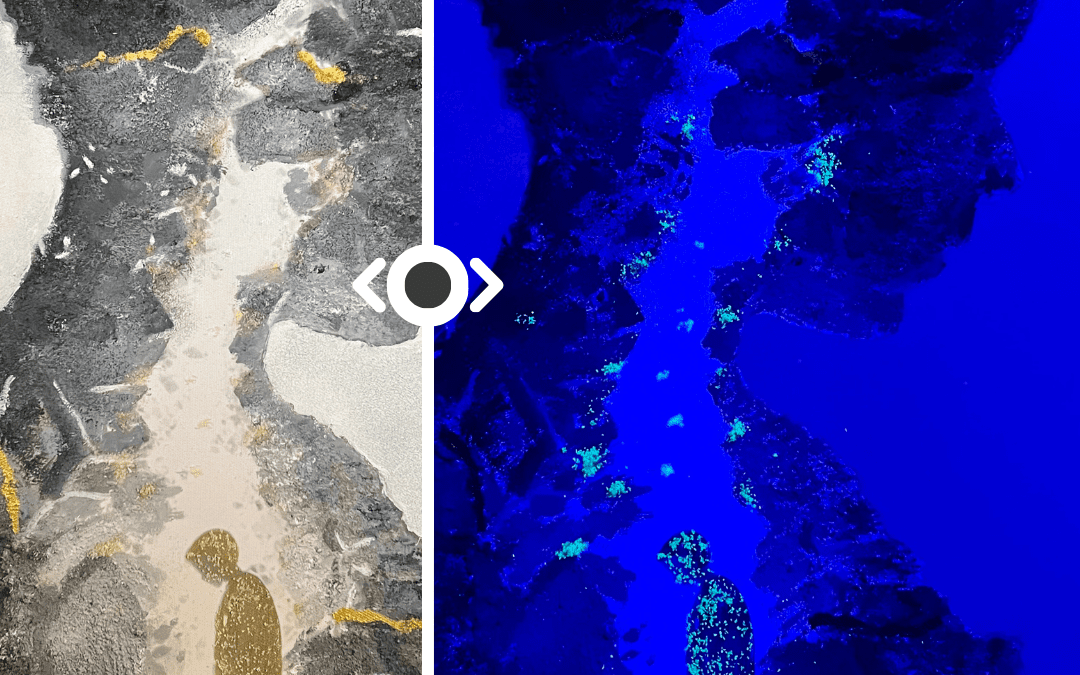
A work becomes an experience when something shifts as you view it: through distance, light, details, material, surface, or a second glance. When the viewer’s life experiences flow into the work. Perhaps you first discover the motif. Then a structure. Then a trace that previously seemed invisible. Perhaps the effect changes in the evening. Perhaps black light reveals something that was only hinted at in daylight. Perhaps an element continues to glow after the room has grown dark again.
Art as an experience that doesn’t reveal everything right away. That’s what I love.
I want to create works that people can look at again and again without them losing their appeal. Images that invite you in—not with a finished product, but with the opportunity to discover something for yourself.
Hybrid: The Fusion of Different Worlds
In my work, “hybrid art” means more than “a little digital and a little analog.” It is neither a decorative mix nor a technical trend. “Hybrid” describes my way of working. Different media, methods, and ways of thinking intertwine until they give rise to a work of its own.
Depending on the series and image, this includes research and concept development, AI-generated image ideas or image components, digital editing, printing on canvas or fine art paper, painterly retouching with acrylic, oil, metallic, or neon paints, UV-reactive or phosphorescent elements, accompanying texts, and various lighting conditions such as daylight, black light, or darkness.
Not every work contains all of these elements. “Hybrid” does not mean that everything must always happen at the same time. “Hybrid” means that every work arises from a deliberate combination of different levels.
Sometimes painting takes center stage. Sometimes it’s digital composition. Sometimes it’s the material. Sometimes it’s the changing light. What matters most is the interplay.
Why AI Is No Substitute for Me
In my work, AI is not a substitute for my decisions, my hand, or my eye. Rather, it is a partner in the process. It brings something foreign into my life: an impulse that challenges me, unsettles me, or drives me crazy.
I use AI to spark ideas for images, explore variations, and open up visual possibilities. Then comes the part where it gets really personal: selecting, discarding, editing, painting over, waiting, and looking again. For me, a digital image is never a finished product. It becomes raw material that goes through many decisions.
I am drawn to this space in between. Technology brings speed, chance, and sometimes a certain sense of strangeness. Painting brings physicality, time, and resistance. A tension arises between the two that I cannot fully plan, but which I very consciously nurture.
Research as an Invisible Layer
Many of my series begin with a question.
How does the city influence our thinking?
How do memories change over time?
What remains beneath a surface that cracks?
How do internal processes manifest themselves in external structures?
These questions interest me because they always open up new perspectives. It’s not just about finding an answer. It’s about looking at things differently—for example, at the city, at memories, at change, and at the things we take for granted at first glance. I often jump to conclusions myself, and I’d like to change that.
That’s why I do research. I read, collect, compare, and let my thoughts sit side by side for the time being. Psychology, society, philosophy, perception, urban spaces, memory, and transformation all flow into my work in different ways. Some traces become visible later; others remain in the background. Nevertheless, they alter the image: the composition, the material, the title, and sometimes even the way a work reacts to light.
Many images are accompanied by short texts. These texts do not fully explain the work, but rather provide a context for it. A single sentence can change the way we look at it. It can highlight a detail, reveal a mood, or suggest a meaning that was previously hidden.
This creates a layer that you don’t have to see directly to feel it. It gives the work depth and (hopefully) helps prevent it from remaining merely superficial.
Light as Part of the Work
In my work, light is not just illumination. It can become part of the image.
A work of art can function fully in daylight and still reveal an additional layer under UV or black light. Fluorescent colors can reveal details that were previously hidden. Phosphorescent elements can create a different atmosphere in the dark. Metallic surfaces can change depending on the viewing angle.
However, that doesn’t mean a work has to be “activated” all the time. The second light is not a permanent state, but a beautiful and exciting possibility.
Figurative, abstract—or somewhere in between?
My works are not purely abstract. They often feature motifs, figures, urban structures, symbols, or recognizable forms. But these elements are not simply depicted. They are superimposed, shifted, condensed, or combined with other layers.
I’m interested in the space in between: when something remains recognizable but isn’t completely defined. When a motif sets a direction but leaves room for one’s own thoughts. When reality and imagination aren’t clearly separated.
This, too, is hybrid: not just technically, but visually and conceptually.
What Defines Experience & Hybrid Art
Experience & Hybrid Art is art that allows for multiple interpretations.
You can experience them intuitively at first: through color, light, material, and motif.
You can explore them more deeply: through concept, text, research, and symbolism. You can alter them through lighting, distance, and the direction of the gaze.
And you can come back, because not everything was visible the first time.
It combines craftsmanship and technology, research and emotion, control and chance. It remains open enough to allow for personal discoveries, yet precise enough to avoid becoming arbitrary.
Why I Chose This Term
The term “Experience & Hybrid Art” feels more fitting for my work because it clearly identifies two things.
First: My art is meant to be experienced.
Second: It arises from hybrid processes.
The point is not to make art more complicated. It is to honestly describe how it is created and how it is meant to have an effect. My works do not come from a single source. They are built up from many layers: technical, thematic, material, and emotional.
Perhaps that is precisely what is relevant today: art that doesn’t have to choose between analog and digital. Art that makes use of technology without losing its craftsmanship. Art that reveals that perception is never limited to a single level.
In short
Experience & Hybrid Art is art that you don’t just look at—you experience it. It combines digital technologies, AI-powered processes, research, painting, materials, and light to create multi-layered works.
Not every image makes use of everything. But each one is the result of a hybrid approach.
Take a look and become part of the picture. Come join us on this adventure.